



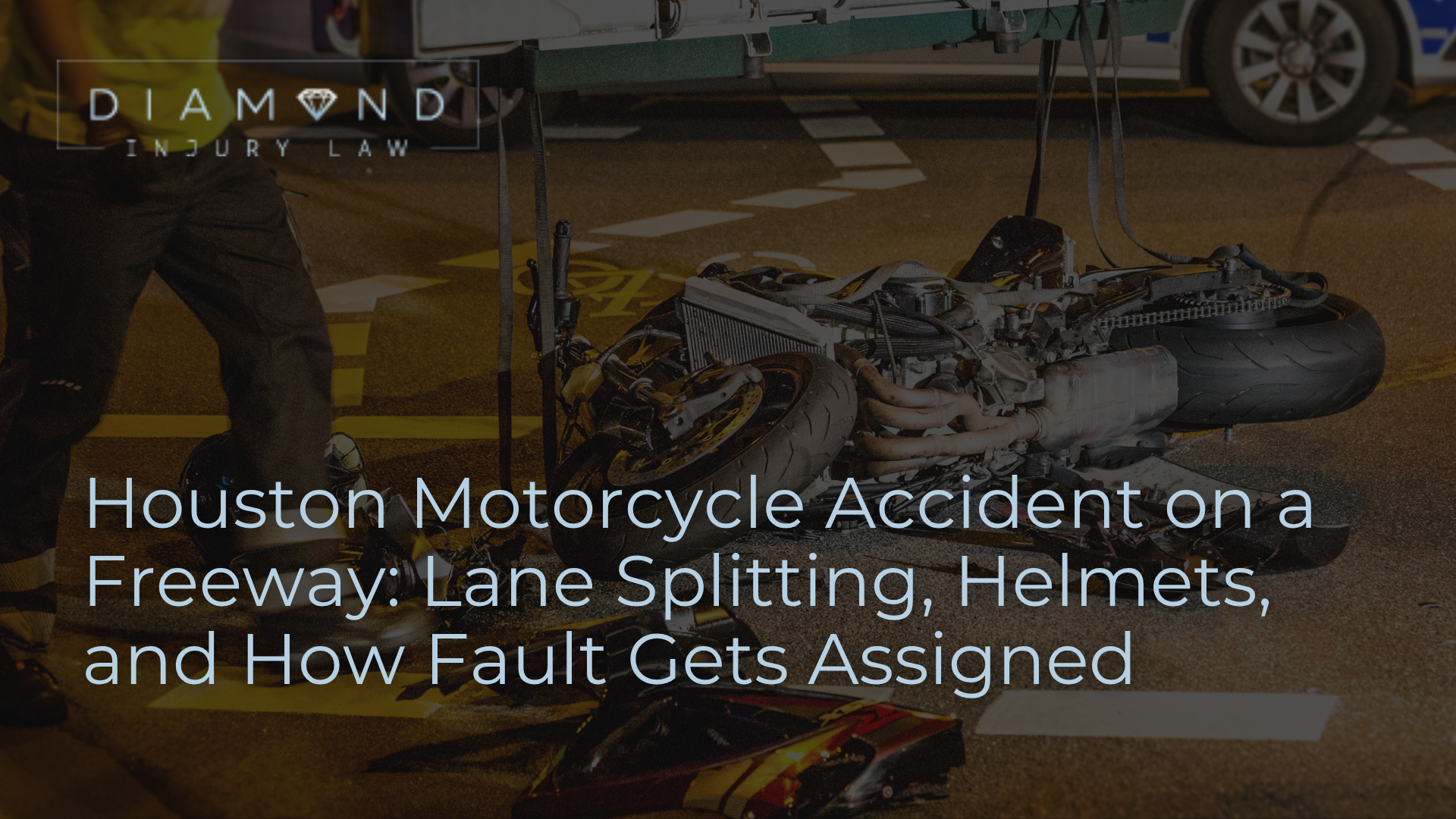
When a motorcycle accident happens on a Houston freeway, fault is rarely straightforward. Insurance companies look for every reason to shift blame onto the rider, and Texas law gives them several angles to work with. Understanding how lane splitting, helmet use, and rider behavior factor into a fault determination can mean the difference between a fair recovery and a denied claim.
If you were injured in a motorcycle accident on I-10, I-45, US-59, or any other Houston freeway, what you do next matters.
Lane Splitting in Texas: What the Law Actually Says
Lane splitting is one of the first things an adjuster will raise after a Houston freeway motorcycle accident. The term refers to a motorcycle riding between two lanes of slow-moving or stopped traffic.
Texas law does not permit lane splitting. Unlike California, which formally legalized the practice, Texas has no statute authorizing motorcycles to share a lane with another vehicle or ride between lanes of traffic. Riding in a way that is not consistent with a single lane of traffic may be treated as a traffic violation.
What This Means for Your Claim
If you were lane splitting at the time of the accident, the insurance company will use it. They will argue:
- You were operating outside the rules of the road
- Your lane position contributed to the crash
- Your fault percentage should be increased accordingly
Under Texas Civil Practice and Remedies Code Section 33.001, Texas follows a modified comparative fault rule. If your share of fault exceeds 50 percent, you are barred from recovering anything. If it is at or below 50 percent, your compensation is reduced by your fault percentage.
Lane splitting alone does not automatically end a claim. But it gives the insurer a number to work with, and that number needs to be challenged with evidence.
What About Lane Filtering?
Lane filtering, where a motorcycle moves through stopped traffic at a light, is sometimes treated differently in public conversation but carries the same legal uncertainty in Texas [VERIFY whether any Texas legislation has been introduced or passed on lane filtering]. Until Texas law changes, both practices carry risk in a fault analysis.
Helmet Laws in Texas and How They Affect a Claim
Texas requires motorcycle riders under the age of 21 to wear a helmet. Riders 21 and older may ride without a helmet if they meet one of two conditions:
- They have completed a motorcycle operator training course approved by the state
- They are covered by a health insurance plan that includes motorcycle accident injuries
Does Not Wearing a Helmet Reduce Your Compensation?
This is one of the most common questions after a Houston motorcycle accident, and the answer is more nuanced than most people expect.
Texas follows the doctrine of proportionate responsibility. If an insurer or defense attorney can show that not wearing a helmet contributed to the severity of your head or neck injuries, they may argue your damages should be reduced by your percentage of fault for that outcome.
The key distinction is this:
- Not wearing a helmet does not affect liability for the crash itself
- It may affect the damages tied to injuries a helmet could have prevented
- Injuries unrelated to head or neck trauma are not affected by helmet use at all
In practice, this means a rider without a helmet who suffered a broken leg and road rash is in a very different position than one who suffered a traumatic brain injury. Documenting the nature and cause of every injury from the start of treatment is critical.
How Fault Gets Assigned in a Houston Freeway Motorcycle Accident
Freeways create specific fault challenges that a standard intersection crash does not. Speeds are higher, lane changes happen fast, and commercial vehicles are a constant presence. The evidence required to establish what actually happened is different from a surface street collision.
At Diamond Injury Law, we treat the first 48 hours after a motorcycle crash as the most critical window in the case. Evidence that exists the day of the accident may be gone within days.
Key Evidence in a Houston Freeway Motorcycle Accident
Traffic camera footage
TxDOT maintains camera infrastructure across Houston’s major freeways. That footage typically overwrites within days. Preservation letters need to go out immediately.
Event data recorders
Most modern vehicles involved in the crash carry a black box that captures speed, braking, and steering inputs in the seconds before impact. Recovering that data requires a timely preservation request before the vehicle is repaired or sold.
Witness accounts
Freeway witnesses rarely stop. Identifying them requires reviewing traffic camera footage for surrounding vehicles, canvassing nearby businesses with parking lot cameras, and working through the police report for any contact information recorded at the scene.
Skid marks and physical evidence
Road crews clear debris quickly on Houston freeways. A scene investigation needs to happen fast.
How Insurers Attack Motorcycle Claims Specifically
Insurance companies approach motorcycle accident claims differently than car accident claims. Riders are often presumed to be at fault before the investigation even starts. Common tactics include:
- Arguing the rider was speeding based on the severity of the impact
- Raising lane position as a contributing factor even when lane splitting was not involved
- Using the absence of a helmet to inflate the rider’s fault percentage on injury claims
- Disputing causation when there is any gap in medical treatment after the crash
Each of these arguments can be countered. But countering them requires evidence that was preserved early and a case that was built before the insurer set the narrative.
Texas Comparative Fault and What It Means for Motorcycle Riders
Texas does not require a rider to be completely without fault to recover compensation. Under Texas Civil Practice and Remedies Code Section 33.001, a rider who is found 30 percent at fault on a $300,000 claim recovers $210,000. The same rider found 51 percent at fault recovers nothing.
That threshold is what insurance companies are working toward when they raise lane splitting, helmet use, and rider behavior. Every percentage point they add to your fault column reduces what they owe.
The goal of a strong motorcycle accident case is not to claim the rider was perfect. It is to build the evidence that accurately reflects what happened and resists the insurer’s attempt to inflate the rider’s share beyond what the facts support.
Frequently Asked Questions About Motorcycle Accidents
Is lane splitting legal in Texas?
No. Texas law does not authorize lane splitting or riding between lanes of traffic. If lane splitting was a factor in your accident, the insurance company will likely argue it contributed to the crash and attempt to increase your percentage of fault as a result.
Does not wearing a helmet affect my motorcycle accident claim in Texas?
It may affect the damages tied to head or neck injuries if the insurer can argue a helmet would have reduced their severity. It does not affect liability for the crash itself, and it has no bearing on injuries unrelated to head trauma. Texas follows proportionate responsibility, so the impact depends on the nature of your specific injuries.
How is fault determined in a Houston motorcycle accident?
Fault is determined through a combination of the police report, physical evidence, traffic and surveillance camera footage, witness accounts, and vehicle data. On Houston freeways, camera footage and event data recorders often carry more weight than driver statements alone because speeds and lane changes are harder to reconstruct from memory.
What damages can I recover after a motorcycle accident in Texas?
Recoverable damages may include medical expenses, lost income, future care costs, pain and suffering, and loss of enjoyment of life. The specific damages available depend on the severity of your injuries and the circumstances of the crash. Texas does not cap non-economic damages in standard auto negligence cases, so the full impact of your injuries may be on the table.
Speak With a Houston Motorcycle Accident Lawyer
Insurance companies move quickly after a fatal or serious motorcycle accident. Their adjusters are experienced, and their goal is to close the claim for as little as possible.
The attorneys at Diamond Injury Law will review what happened on that freeway, assess how fault is likely to be framed by the other side, and make sure your case is built to push back. You should not be navigating this process alone while recovering from serious injuries. Contact us today.

